Drum machines and synthesisers were heralded as the “beginning of the end” of contemporary music. The digital audio workstations were claimed to be the final nail in the coffin of modern music. However, as a result, nothing but a new influx of creativity and a slew of new music to discover ensued.
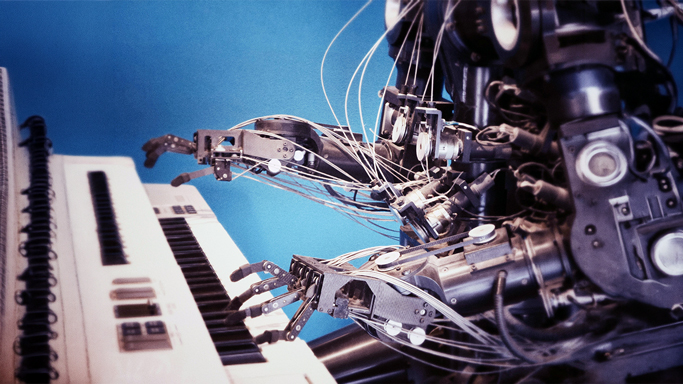
Recent work from the fields of AI (Artificial Intelligence) has started permeating the music world, with entire songs as well as song sections or rhythms, chord progressions, and melodies appearing (plagiarised!) in AI songs. This has resulted in a flood of outrage and fear from musicians. Like every nascent technology, there are legal, ethical and industrial issues that shape artists and the industry as a whole.
Technology is developing at a pace that is leaving a lot of people aghast at what can be produced by something as trivial as an algorithm or data analysis. While much of music made by computers is cold, clinical, and soulless, it can also be breathtaking when it shows pure invention and creativity derived from the immense universe of songs existing when it was trained. The fact that AI looks back on existing music is nothing more than the typical approach that any composer engages with to think of or produce a new song.
As a large proportion of released music becomes the creation of machines rather than art made by men, a serious problem arises: copyright. Copyright grants creators of original work exclusive rights to have one or more of their works do all of the things you want them to, or sell those rights to someone else. Human artists who make music also automatically receive copyright, which lets them determine whether a third party can remix or sell their work. But what happens when music comes from a machine? Who owns the rights to music produced by that AI program if it is trained on music created by human artists? Should the company that created the technology that created the song own the music? Or should artists who made the work that the AI used to inform the training to learn how to compose music in the first place have a say? It’s a really hard legal grey area to navigate. So far, there aren’t any laws that cover the rights of both human creators AND AI developers who are able to produce award-winning music.
Music is considered so much more than just a jumble of notes that get turned into sounds, lyrics, chord progressions, and melodies. Music is experienced through more than the senses, and so is able to trigger and articulate emotion in humans, emotions that an AI cannot (yet) emulate. This is part of why so many people fret that not only music but human emotion generally is threatened by this tech. Realness and emotion – this is why people relate and listen to music. AI is said to be incapable of replicating that.
I think this position is rubbish. To a large extent, everything in human-made music can be traced back to existing individual melodies, chords or “sound”. Even lyrics may not be one-off for the vast majority of songs. So at its core, most human-written and performed music plagiarised something even if they didn’t intend to.
But the truth is that this argument boils down to dollars. One must ask themselves of this increasingly complex world whether, as music production starts to automate into a more advanced form, there will be no shortage among musicians or songwriters. So, if AI is ultimately going to take over making music, what happens to the musician and songwriter working in the industry? Will AI music be good for the music industry? Will musicians and composers disappear?
In the foreseeable future, I wonder about this validity. I doubt that talented artists will disappear. But, AI music is capable of generating huge quantities of music quickly and inexpensively. Because of that, as record labels look for cheaper substitutes to fill album space or create jingle tunes that catch the ear of advertising and commercial audiences, human artists are likely to play an inferior role. Only dull, cookie-cutter sounds will be brought forward as a result. True? I doubt it.
AI could outperform musicians in the future; not yet, but even now, it can be an important tool for human musicians. AI is becoming something many artists use as the blueprint for their next pieces of music. AI can lead to fresh ideas, beat writers’ block, and new material for music, in the hands of human artists using the help of melodies, chord progressions, lyrics and more generators. Some people will love the new music made and even be intrigued by the music they listen to, while others will hate it and stick to the old, human-made version of music. Either way, the world gets a new kind of music to be available, and in a very divided market, both AI music and human music will co-exist. But with it, there is a downside: Badly made music could soon be pouring into the world.
“Badly made” music is not going to be a success and be picked up, be it human or AI-created. There is an opportunity for both human ingenuity and AI-produced work in music’s future. At the same time, legal infrastructure must be designed to protect creators while making the kinds of technological innovations currently available. Ultimately, what will lend music value, regardless of the human or artificially derived origins, is the way in which it affects all of us: how it changes our emotions, how we see our worldviews, and our perspective on it.